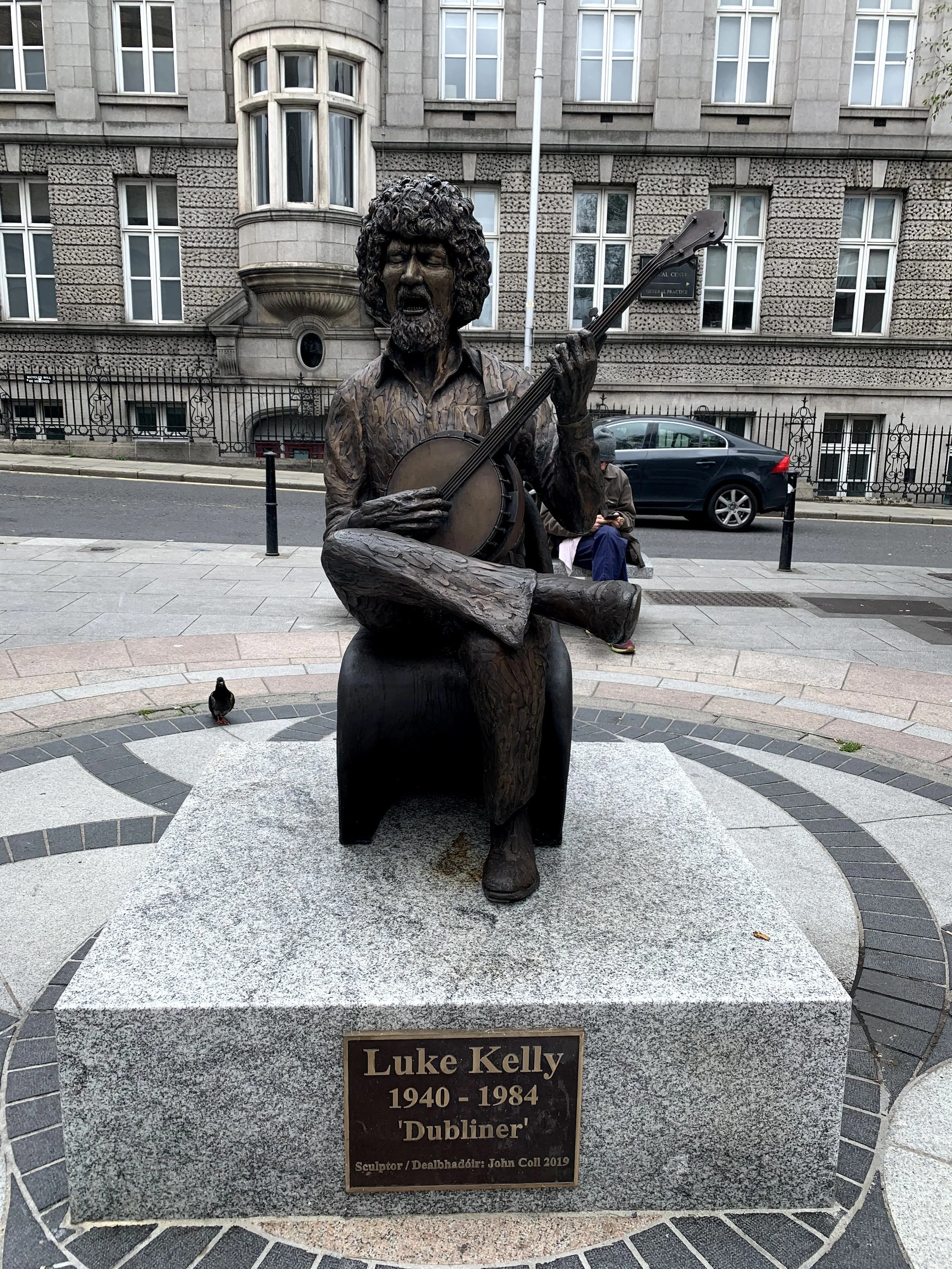
Luke Kelly Statue, South King Street, Dublin
The Voice That Shook Ireland
Introduction
On South King Street in the heart of Dublin, just a stone's throw from the buzz of Grafton Street and the green expanse of St Stephen's Green, a bronze figure sits mid-song, banjo in hand, head thrown back, eyes closed — lost entirely in the music. This is Luke Kelly, one of the founding members of The Dubliners and arguably the most powerful folk voice Ireland has ever produced. Sculpted by John Coll and unveiled in 2019, the statue captures Kelly exactly as his fans remember him — raw, passionate, and utterly alive with the music.
There are actually two Luke Kelly statues in Dublin, both by John Coll, both unveiled on the same day in 2019. The second stands on Sheriff Street Upper in the north inner city, close to where Kelly grew up. That there are two is entirely fitting. Luke Kelly was too big for one statue.
The Statue
The South King Street statue places Kelly in the cultural heart of Dublin city centre, surrounded by theatres, venues and the creative life of the city that he helped define. Sculptor John Coll spent considerable time researching Kelly's life and performances before creating the piece. The result is a statue of remarkable energy — Kelly mid-performance, completely absorbed, the banjo almost vibrating with life.
The plaque reads simply: Luke Kelly 1940–1984 'Dubliner'. Sculptor / Dealbhadóir: John Coll 2019.
It says everything it needs to.
The Story Behind the Man
Luke Kelly was born on 17 November 1940 in Sheriff Street, Dublin — a working class northside community with a fierce sense of identity. He left school young and spent time in England in his teens, working various jobs while immersing himself in the folk revival scene sweeping Britain at the time. It was in England that he fell deeply in love with traditional Irish music, political song, and the raw power of the folk tradition.
He returned to Dublin and in 1962, along with Ronnie Drew, Barney McKenna and Ciarán Bourke, formed The Dubliners. What followed was one of the most remarkable careers in Irish musical history. The Dubliners became the defining voice of Irish folk music — raucous, political, sentimental and utterly authentic — and at the centre of it all was Kelly's extraordinary voice.
His voice was unlike anything Irish music had heard. A rough, searingly emotional instrument that could strip a song down to its bones and rebuild it as something transcendent. When Kelly sang Raglan Road, the Patrick Kavanagh poem set to an ancient air, he didn't perform it — he inhabited it. When he sang Scorn Not His Simplicity, written by Phil Coulter about his son who had Down syndrome, he reduced audiences to silence. These were not party pieces. They were moments of genuine human connection.
Kelly was also a man of deep political conviction — a committed socialist who used his platform to speak out against injustice and poverty, and who saw traditional music as inseparable from the working class communities that had kept it alive.
He died on 30 January 1984, aged just 43, following a long battle with a brain tumour. Dublin mourned him as one of its own. Forty years later, that mourning has never fully lifted — it has simply transformed into something closer to fierce pride.
Where to Find It
South King Street, Dublin 2. The statue is located just off Grafton Street, beside the Gaiety Theatre and a short walk from St Stephen's Green.
The second Luke Kelly statue stands on Sheriff Street Upper, Dublin 1, close to the Custom House on the northside — nearer to the community where Kelly was born and raised.
Getting there: From Grafton Street, turn onto South King Street and the statue is immediately visible. Green Luas line to St Stephen's Green is a two minute walk.
Best time to visit: Morning light works well as the statue faces outward toward the street. Weekday mornings are quietest for photos.
Did You Know?
Luke Kelly's face has appeared on a special commemorative Irish coin issued by the Central Bank of Ireland — one of very few musicians to receive this honour.
The unveiling of two identical statues on the same day in 2019 sparked considerable public debate about which was the better likeness, with passionate opinions on both sides. The controversy only added to their profile and brought new attention to Kelly's legacy.
Kelly's version of Raglan Road is widely considered the definitive recording of the song. His interpretation reportedly had the approval of Patrick Kavanagh himself, who was famously particular about how his work was treated.
The Dubliners performed for over five decades, but for many fans the band was never quite the same after Kelly's death. His voice had been the emotional core around which everything else orbited.
Nearby Statues
From South King Street you're within easy walking distance of some of Dublin's finest statues. Phil Lynott is a short stroll up Grafton Street on Harry Street. We have pages for the Famine Memorial and Oscar Wilde nearby. More coming soon.