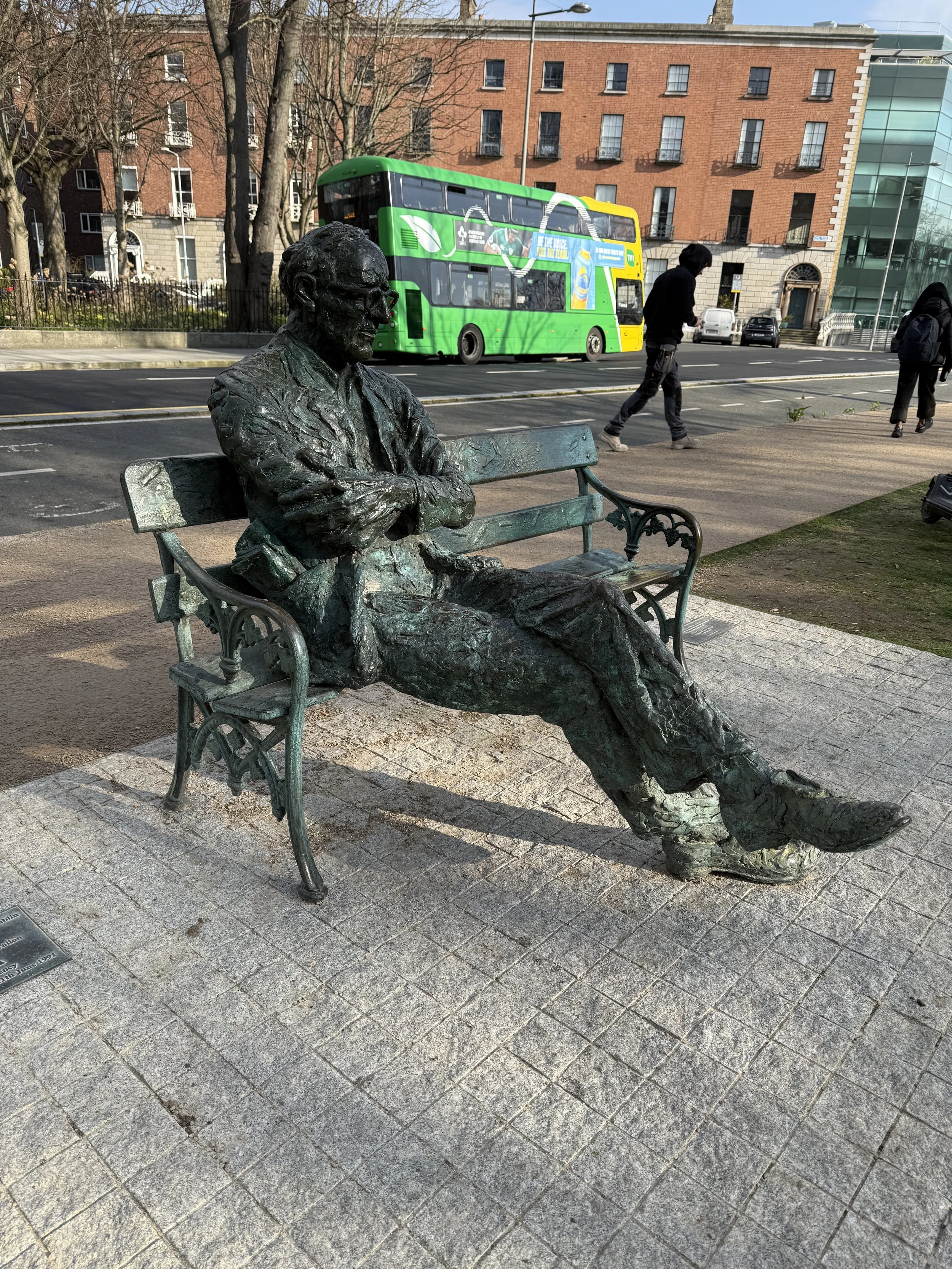
Patrick Kavanagh Statue, Grand Canal, Dublin
A Canal-Bank Seat for the Passer-By
Introduction
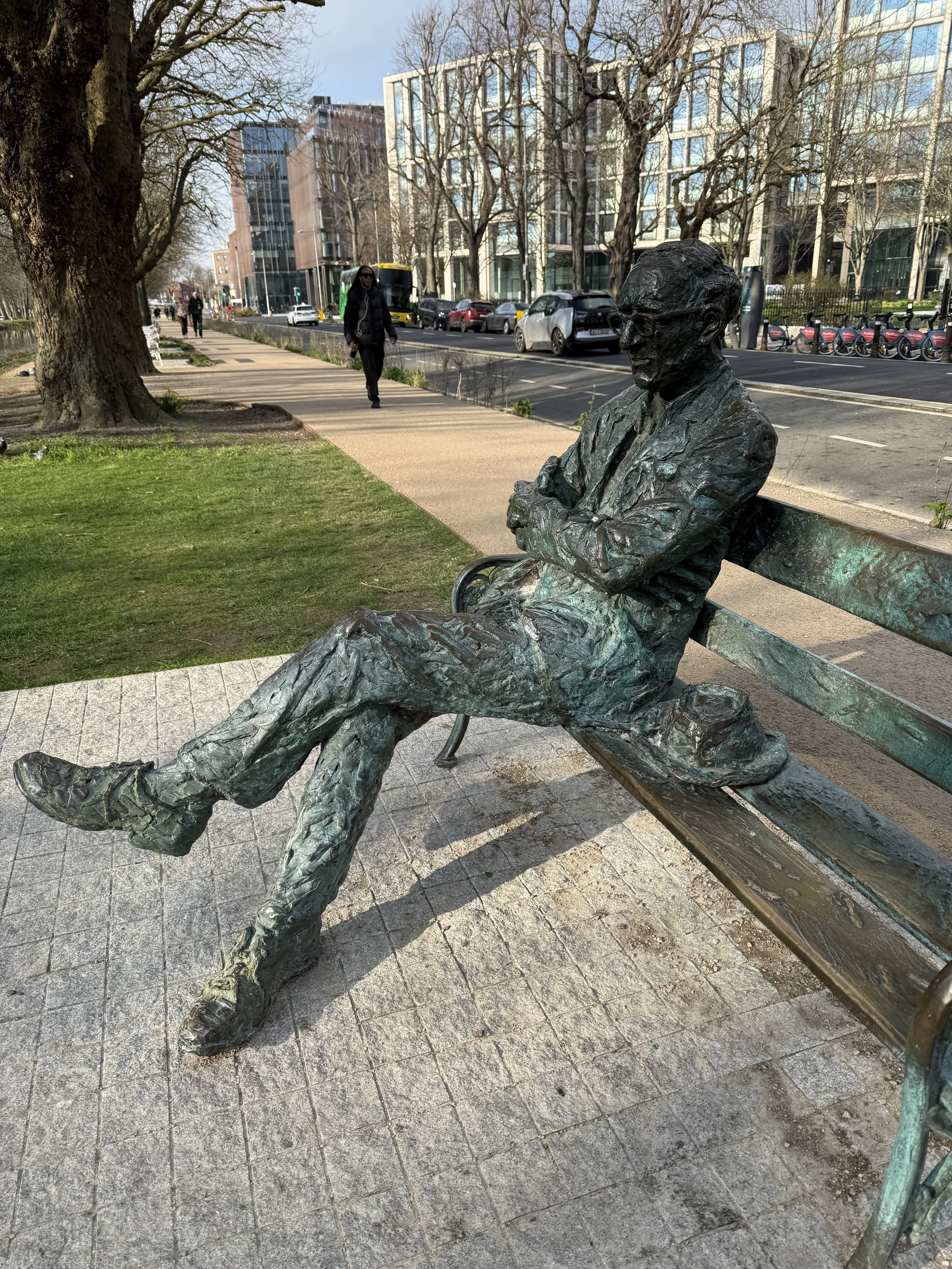
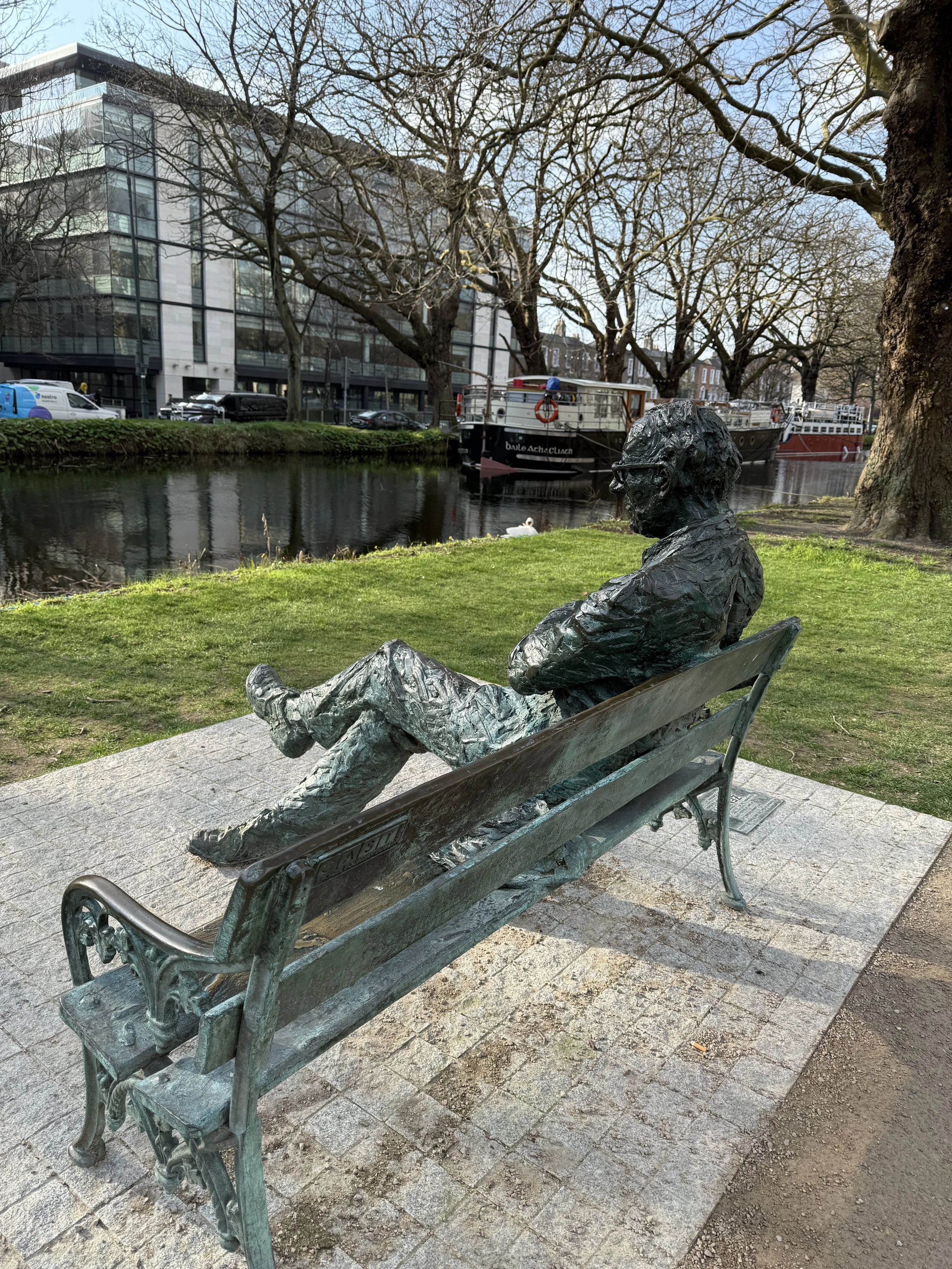
On the north bank of the Grand Canal at Wilton Terrace, between Baggot Street Bridge and Leeson Street Bridge, a bronze figure sits sprawled on a bench, arms folded, legs stretched out, head tilted slightly, watching the water. He looks like a man who has nowhere better to be, and knows it. This is Patrick Kavanagh, one of the greatest Irish poets of the twentieth century, and the bench is exactly where he asked to be remembered.
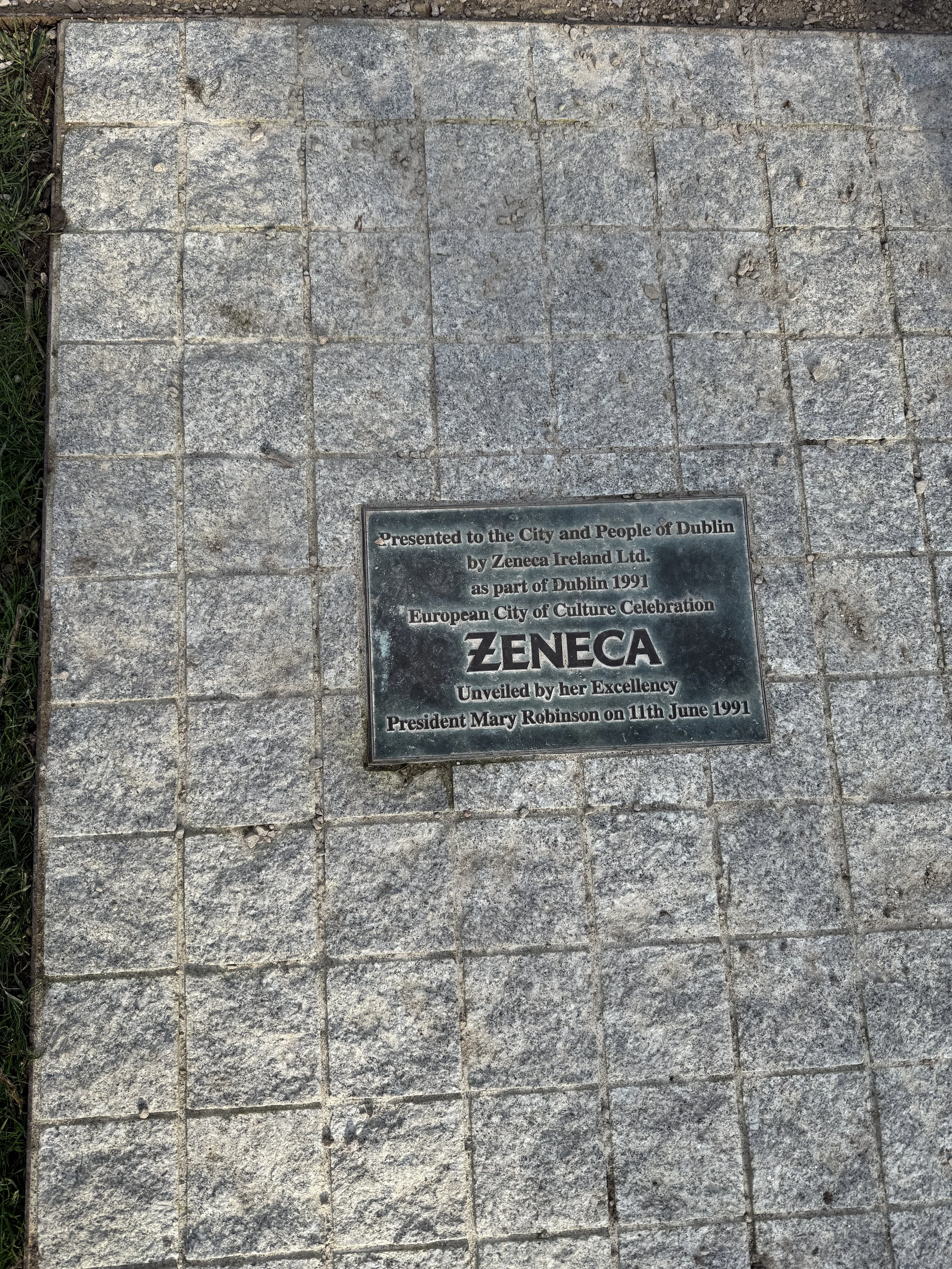
The sculpture was commissioned as part of the Dublin 1991 European City of Culture celebrations and unveiled on 11 June 1991 by President Mary Robinson. It was created by figurative sculptor John Coll, commissioned by ICI Ireland. Coll's aim, in his own words, was to capture the physicality of the man, something of the poet in him, and that contemplative look Kavanagh often held in a similar position on his favourite canal bank seats. He succeeded. Sit beside him and you'll feel it immediately.
The Statue
The sculpture shows a reflective Kavanagh sitting thoughtfully, his hat beside him on the bench. He seems to offer a sympathetic, non-judgmental ear to passers-by, inviting them to sit down and have a chat. The modelling is deliberately rough and textured, this is not a smooth, heroic monument. It is a man at rest in his favourite place.
The plaque beside the statue carries lines from his poem Canal Bank Walk:
Leafy with love banks and the green waters of the canal / Pouring redemption for mePatrick Kavanagh 1904–1967 / Sculptor John Coll
The statue is one of the most photographed locations in Dublin, and was conserved in situ during a major public realm upgrade of the canal towpath completed in 2025, where it now sits on a new granite base.
The Story Behind the Man
Patrick Kavanagh was born on 21 October 1904 in Mucker, Inniskeen, Co. Monaghan. Having attended the local national school, Kavanagh worked as an apprentice shoemaker to his father and then on the small family farm. He was largely self-educated, and began submitting poems to Dublin literary journals in his late twenties while still working the land. His first collection, Ploughman and Other Poems, was published by Macmillan in 1936, while he was still working "the stony grey soil" of the farm.
In 1939, Kavanagh moved to Dublin, where he became a full-time writer, contributing articles and poems to a number of publications.The city did not entirely welcome him. Dublin's literary establishment viewed him as a culchie, a bogman, talented but rough-edged, not quite one of their own. Kavanagh gave as good as he got, dismissing most of the city's literary scene as dandies and civil servants playing at art.
What he produced in those years, however, was remarkable. The long poem The Great Hunger, published in 1942, challenged the romantic pastoral visions of the Irish Revival writers with a semi-autobiographical depiction of the misery of the bachelor farmer. It is one of the most powerful poems written in Ireland in the twentieth century, unflinching, angry, and devastatingly precise about the psychological damage of rural Irish life.
Then came the illness that changed everything. Following a serious illness in 1955, Kavanagh spent much of his convalescence on the banks of Dublin's Grand Canal. Here, he experienced a spiritual awakening and his poetry flourished with a new strength of purpose. He wrote of it himself: "For many a good-looking year, I wrought hard at versing but I would say that, as a poet, I was born in or about nineteen-fifty-five, the place of my birth being the banks of the Grand Canal."
The canal poems that followed — Canal Bank Walk, Lines Written on a Seat on the Grand Canal — are luminous, grateful, wholly different in spirit from The Great Hunger. They are poems of a man who has come through something terrible and found himself, unexpectedly, on the other side of it, watching the water.
His poem On Raglan Road, written in 1946 but popularised by Luke Kelly of The Dubliners, became one of the best-known Irish songs. The connection between Kavanagh and Kelly, two of the defining voices of mid-century Ireland, is one of the great threads running through Dublin's cultural life. We have a page on Luke Kelly too.
Kavanagh died on 30 November 1967 in Dublin. His grave is in Inniskeen, adjoining the Patrick Kavanagh Centre.
Where to Find It
Wilton Terrace / Mespil Road, Dublin 4. The statue sits on the north bank of the Grand Canal between Baggot Street Bridge and Leeson Street Bridge. It faces the water directly, find a gap in the towpath railings and you'll see him.
Getting there: A fifteen-minute walk from St Stephen's Green, or ten minutes from Baggot Street. The nearest Luas stop is Charlemont, five minutes on foot. Several bus routes stop on Baggot Street.
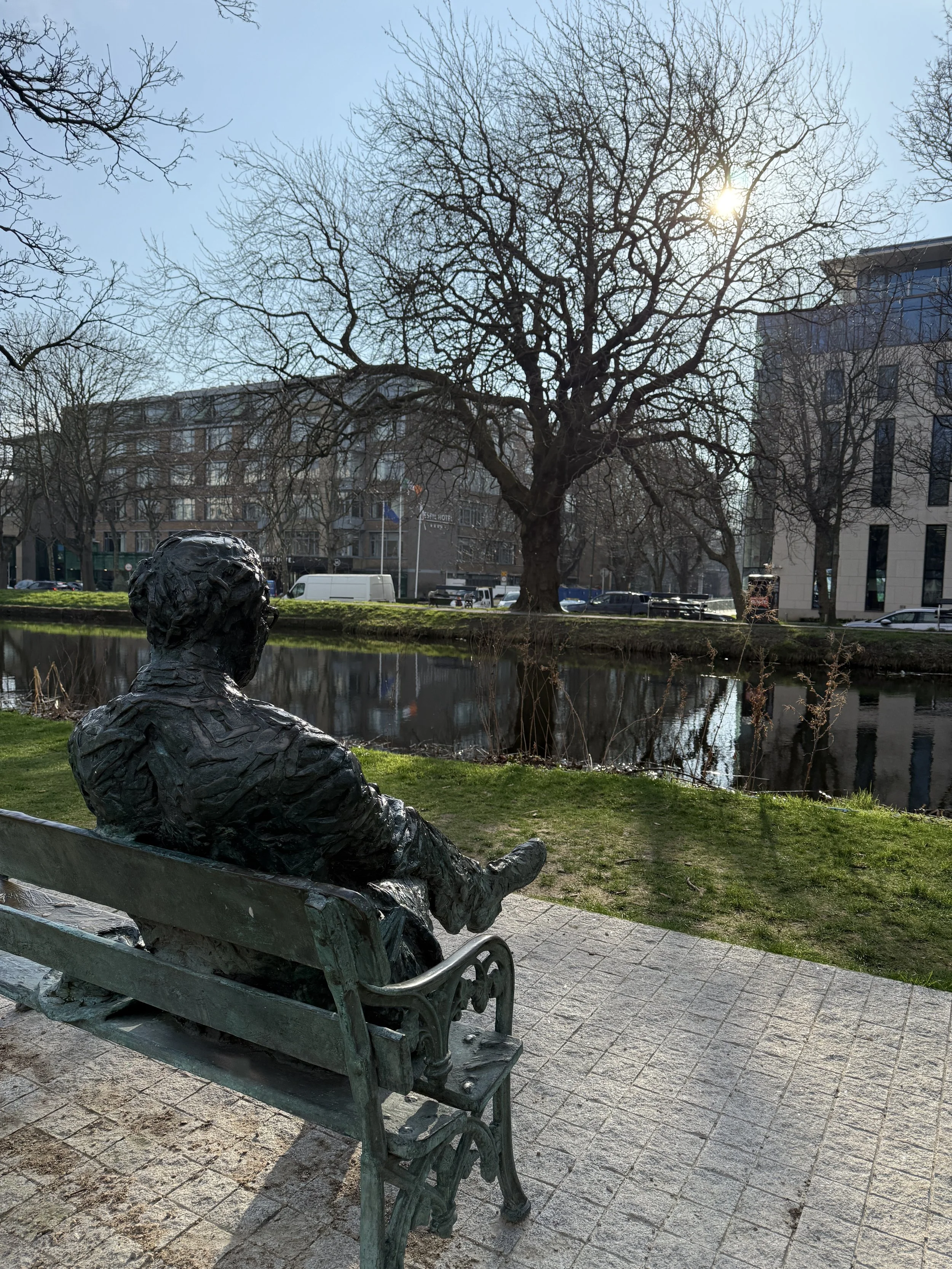
Best time to visit: Morning light is exceptional here, the canal reflects the sky and the trees, and the bench faces east. Your Image 2 captures exactly why this location is so special at that time of day. Avoid midday when the sun is directly overhead.
Did You Know?
There are actually two seats dedicated to Kavanagh on the Grand Canal. The first, a simple wood and granite bench with no figure, was erected by his friends John Ryan and Denis Dwyer shortly after his death in 1968, on the south bank at the Lock Gates near Baggot Street Bridge. The John Coll statue came more than two decades later. Most visitors only know the second one.
There is also a replica of the Grand Canal bench, with Kavanagh seated on it, outside the Raglan Road Irish pub and restaurant at Walt Disney World's Downtown Disney in Orlando, Florida. Of all the places Kavanagh's spirit might have ended up, that is perhaps the least expected.
Seamus Heaney described the two halves of Kavanagh's career as "a heavenly place" and "a placeless heaven", the dark, rooted world of Monaghan giving way to the luminous, liberated canal poems of his later years. Both halves were necessary. The bench sits at the intersection of the two.
Nearby Statues
The Grand Canal area is rich ground for statue spotting. Oscar Wilde is a short walk away in Merrion Square. Head north across the city and you'll find Luke Kelly on South King Street, the man who gave On Raglan Road to the world. We have pages for both, keep exploring.